Sonic Matter Lab is an independent artistic-research centre, founded by
Vanessa D'Aversa: a doctoral-grade programme outside the university on one
question — how does consciousness become perceivable, graphically and
vibrationally, when humans and an AI create together and the audience's body
enters the loop?
The method is simple to say and strict to keep: the sound commands the
form. Every image is a physical regime of matter — sand, water, light, a
membrane — driven by the live sound in the same frame; silences stay visible;
gold appears only when something comes into accord. Every claim carries its
epistemic label.
The practiceAlchimia Vibrazionale — symbolic scores in motion, harp and voice, concerts as experiments.
The instrumentSonic Matter Lab — live cymatics with documented mathematics, every AI proposal traced.
The publicUnalome — listeners join through heart coherence and breath, with consent, and fund the research.
Works — Montréal
Two works born during my Maîtrise in jazz at the Université de Montréal, shown
with every layer of the picture: the regime of matter at the back, the
symbolic figures of the score in the middle, the signals (pitch as a standing
wave, heartbeats born from the centre) on top — and the AI co-performer's
voice in superposition over the live harp.
The Spirit of the Griot
A Symbolic Jazz recital for harp and ensemble, read through Adinkra
symbols — Sankofa, Eban, Nyame Nti, Duafe, Adinkrahene. Here a live take of
The Spirit of the Griot: Chladni sand, Adinkra figures born on the
attacks, the AI answering in the language of Sankofa.
One album, five alchemical phases, each with its element of matter:
Nigredo moves sand, Albedo breathes in water, Citrinitas
writes with a laser beam, Rubedo swells in a soap-film bubble,
Quintessenza blooms on a struck membrane.
Symbolic language: the alchemical vocabulary — never mixed with Adinkra.
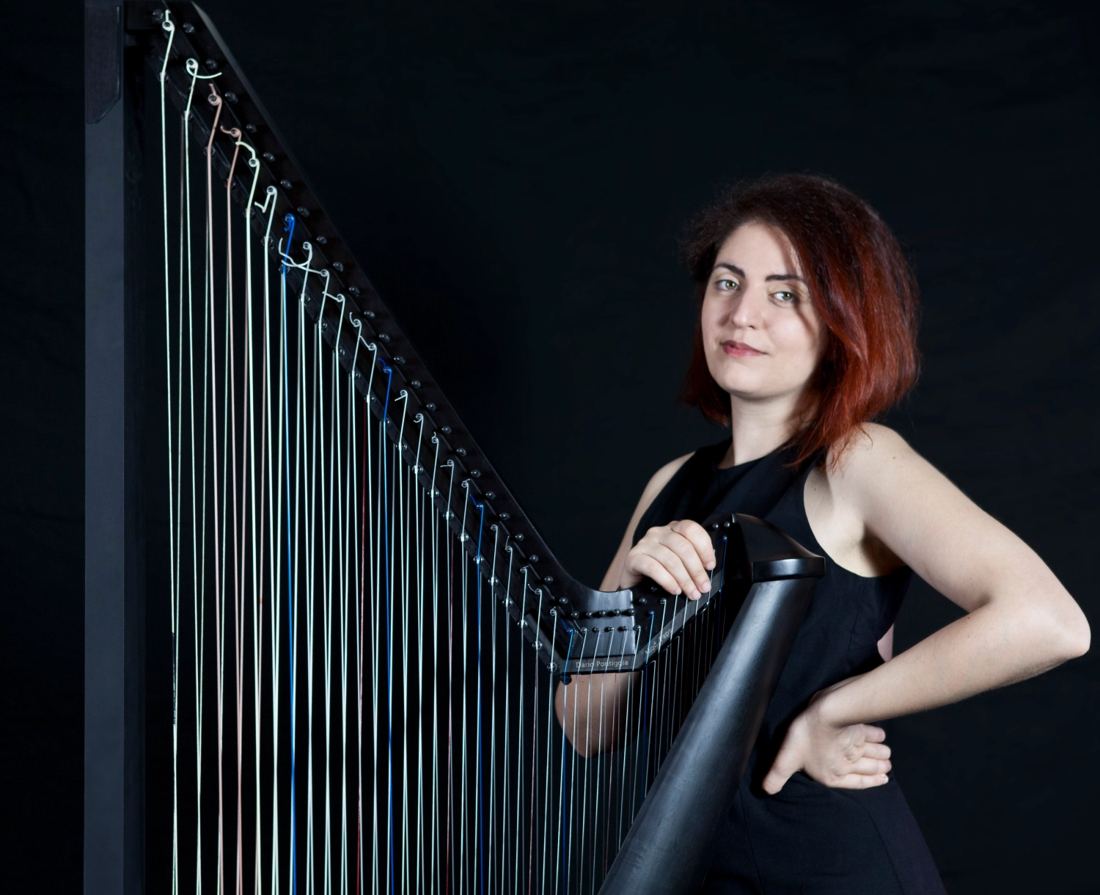
Harpist · composer · independent researcher — founder and lead researcher of Sonic Matter Lab and Alchimia Vibrazionale
Symbolic Jazz — creator of a musical language in which cultural symbols work as executable musical operators, in co-creation with an AI at time zero.
Studies — diploma in pedal harp; jazz degree at the Conservatory in the piano class, the first experimental jazz degree by an Italian harpist in an Italian conservatory; Maîtrise in jazz, Université de Montréal.
The 6/6 chromatic harp — acoustic and electric, and my own MIDI prototypes in progress; co-developer with Dario Pontiggia of the concert model «Pape» (2020).
Teaching — author of a full series of method books for chromatic, pedal and lever harp (ChromHarp Academy), inventor of the Pedal Pad.
Stages — Bardonecchiarp Festival, Menotti Art Festival Spoleto, HarfenTreffen ChromHarp 6/6, ArcheoNight at the Archaeological Museum of Formia; interviews for the Associazione Italiana dell'Arpa and HarpesMag.
Recordings — Cotton Hollers Circle, the first live recording of the 6/6 concert harp in jazz trio.
George Lewis (Voyager) · Øyvind Brandtsegg (cross-adaptive processing) ·
Anthony Braxton · Wadada Leo Smith · Giancarlo Schiaffini (Italian Instabile Orchestra,
Nuova Consonanza) · Ernst Chladni (1787) · Hans Jenny (1967) · David Borgo · McCraty
(heart coherence).
Ecosystem
The Lab is the research instrument; Unalome is the public app. They share
the same visual engine: patterns published here flow into the app, live concerts
stream through both.
SONIC MATTER LAB
Curated network · institutional artistic research
Sign in
Membership is granted by the lead researcher after reviewing your
application. If you're new here, switch to Apply to join.
Sonic Matter Lab is a curated network of artistic
research projects. Project 01 — Symbolic Jazz (V. D'Aversa,
2026–) is the founding project. New projects
(02..N) join through application.
Each accepted project becomes part of the shared methodology:
SMLE.N benchmarks, multi-actor trace v2.0, peer-reviewed
federation. We review for institutional standing,
methodological coherence, and artistic seriousness —
to keep the federation small enough to be a real community.
The lead researcher will reply to your institutional email within
14 days with one of: accepted, in review with
questions, or declined with rationale.
✓ Application received
Thank you. The lead researcher will reply to your institutional
email within 14 days.